Insurance claims automation completely streamlines the claim cycle. It automates FNOL filing, manages underwriting workflow, and provides 24×7 customer support across all communication channels.
Early adopters of claims processing automation, like TPAs, insurance carriers, insurance agencies and brokers automate 80% of claims submissions and FNOL filing by leveraging the power of conversational AI for insurance.
The video below shows a demo of Floatbot’s AI agent, LISA, effectively handling a FNOL and its follow-up status.
Gen AI-powered Claims FNOL Voicebot
Gen AI-powered claim process automation: Overview
Let's understand the insurance claims automation process. These steps will give you a general idea of how automation works for FNOL.
1. Policyholder initiates FNOL
The process starts with the policyholder filing the FNOL through different channels such as voice, call, SMS, or emails.
2. Collect details and real-time validation
The AI agent collects relevant information from the policyholder, like their name and policy number, and understands the cause of damage.
Then, it starts uploading the documents, making sure all the essential files are submitted for a thorough claims review.
With the help of advanced algorithms, the AI agent conducts real-time validation of FNOL details, recognizing and addressing gaps in information.
3. Communicate Claim Status
Based on the information, a claim adjuster is assigned. The AI agent then provides real-time claim updates with the adjuster details to minimize the flow of follow-ups.
The claims adjustor can view all the FNOL details collected and uploaded by the AI agent. In case of any missing piece of information, the agent highlights it for the adjustor to have all the complete information in hand.
4. Settlement & Adjudication
After the information is validated, the system processes the insurance claim. In cases of complex inquiries, the AI agent transfers the query to a live agent.
The live agent gets a detailed brief of the particular claimant so that there is no breakage in the information flow.
Benefits of AI Claims Automation in Insurance
Automating insurance claims using AI changes the way you handle interactions with your claimants.
Moving beyond the limited availability of human agents, claims process automation brings 24/7 contact convenience and manages 80% of claims FNOL and support. Here are some more ways the automation of insurance claims benefits you.
Accurate & faster FNOL filing
Filing First Notice of Loss (FNOL) is faster for your policyholders.
They can start the claim filing process over voice, call, SMS, email for both first and third party claims. This not only benefits them but also the insurance carrier.
AI Agent takes care of data collection, guided reporting, claim type identification, documentation submission, instant confirmation, and follow-up communication. For complex scenarios, a live agent can get involved to ensure the concerns are addressed.
No human dependency
FNOL automation obsoletes the need for a human agent when a policyholder initiates the claim process. Traditional human agent FNOL filing is tedious during busy business hours, leading to longer waiting periods, verification processes, and claim status updates.
An effective AI agent like LISA enables policyholders to initiate claims at any time with great flexibility. They can report incidents immediately after they occur, rather than waiting for their turn to talk to the agent.
Empower claims adjusters
Adjusters often find themselves overwhelmed, especially during peak seasons or after catastrophes when claim volumes surge. The pressure to manage claims while meeting tight deadlines is exhausting and leaves room for error.
AI in insurance for adjusters serves as a copilot, autopilot, collaborator, and real-time assistant. It manages heavy workloads, especially during claim surges. Here is a breakdown of what they can handle.
| Capability Level | Primary Role | Key Features |
| Copilot | Operational Organizer |
|
| Autopilot | Autonomous Executor |
|
| Collaboration | Communication Bridge |
|
| Real-Time Assist | Intelligence Partner |
|
This results in fewer errors, faster claim management , and more time to do what matters.
Proactive claimant engagement
AI in insurance makes the process faster and more accurate, making the claimant feel assured during difficult times. With intelligent automation (IA), they can check the status of their claims in real-time and get quick responses from AI agents.
GenAI-powered automation significantly improves claims processing, making claimants more likely to stick around and keep choosing you over your competitors.
Cost Saving Operations
Inefficient use of resources in the claims support process leads to higher costs and delays in claims fulfillment. Claims automation establishes a foundation for continuous cost savings. As processes become more efficient, you benefit from ongoing operational cost reductions over time.
Common challenges while automating insurance claims
The biggest challenge while automating claims is handling data. Older automation processes generally pull data from different sources, which might not be highly accurate. Modern solutions need a single source of data.
It is always recommended to structure the data before switching to a new automation process. Besides this, other challenges include the following:
- Upfront training and investment cost.
- Outdated data format structures incompatible with modern APIs.
- Complying with insurance data privacy laws.
The best practice here is to first use a modern tech stack to avoid any data mismatch. This will require your due diligence to clean your data and keep only what matters. Secondly, training the AI agent with the right information and the human agent to effectively manage insurance claims process automation without any hindrance.
Get Started with Insurance Claims Automation
The simplest way is to integrate a modern AI agent from Floatbot, where policyholders can connect with the agent via text and call anytime. You don't need to build the agent, it directly integrates with your platform.
Here is how you can get started:
- Define your goal and map out your claim flow.
- Select an AI agent or software to automate the process.
- Train the system with the right set of information.
- Start testing the project and track the interaction.
Tips to pick the right claims process automation partner
No-Code/Low-Code & Easy to Use
A no-code or low-code platform is best for those with limited or no coding expertise to build and deploy AI agents effortlessly. This accelerates the development and deployment lifecycle, allowing you to respond swiftly to changing requirements without relying heavily on a dedicated development team.
Flexibility & Scalability
The AI agent must be versatile and adaptable to various types of claims and processes. It should be able to handle a range of tasks from initial submission to final payout. Additionally, it should be scalable to accommodate growing claim volumes and other functionalities as your organization expands.
Integration Capabilities & Customizations
The AI solution for Insurance should seamlessly integrate with your existing systems and technologies. Its compatibility with other software makes it easy to avoid disruptions. Customization options help to align the AI agent with your requirements. The ability to tailor the automation to your unique requirements ensures a more personalized and effective solution.
Audit Trails and Compliance
The solution offers robust audit trail features to track changes and actions within the system. Compliance with industry regulations is vital, so verify that the automation solution aligns with relevant standards.
Cost-Effectiveness
Consider the overall cost of implementation, including initial setup, licensing fees, and any potential ongoing costs. A solution that provides a good balance between features and cost-effectiveness is essential for a successful investment.
Automate With Ease Now
The automated insurance claims process handles data validation, claim status tracking, pre-authorization, real-time eligibility verification, document digitization, data extraction, claims validation, and fraud detection, as well as the routing and tracking of claims.
Using our AI agents (powered by GenAI and driven by LLMs) to optimize First Notice of Loss (FNOL) filing helps to:
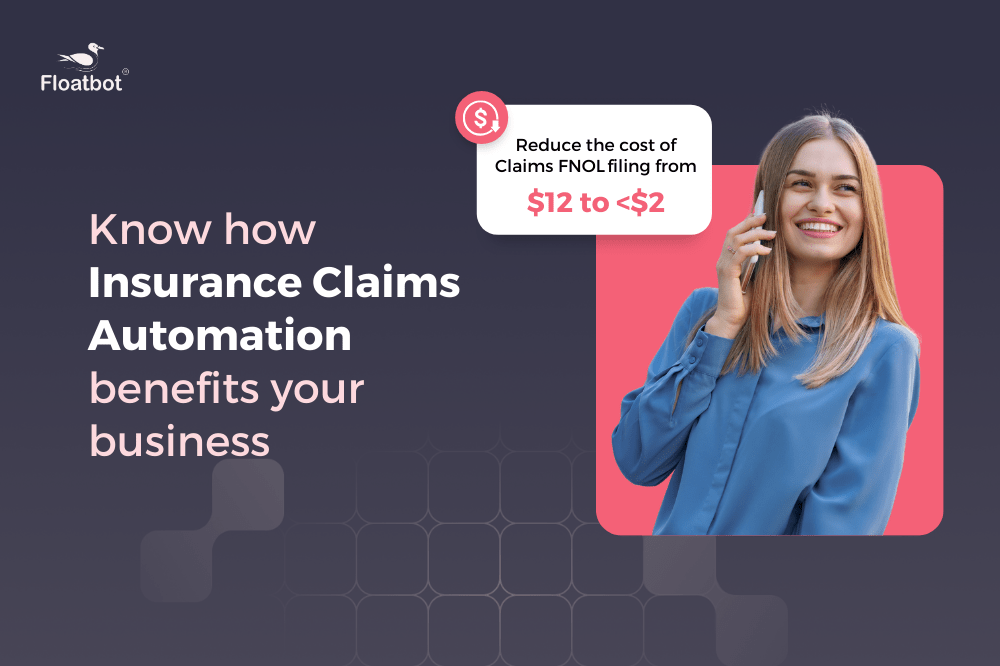
- Reduce costs from $12-$15 to less than $2 per claim.
- 80%-90% of seamless management of FNOL initiation and claim processing.
- Offer real-time 24/7 assistance for status updates and query resolution.