Quick Summary
- Conversational AI in healthcare has evolved from simple, rule-based bots to intelligent AI Agents that act autonomously across clinical workflows.
- It unifies fragmented communication across channels, systems and teams.
- Healthcare organizations use it to shift from reactive support to proactive, always-on engagement at scale.
- Providers, payers and pharmacies benefit through automation of DFD tasks, engagement, eligibility checking, billing queries, reminders and medication workflows.
Healthcare has always been built on conversation. The questions clinicians ask, the answers patients share, the follow-ups that guide care forward. Today, those conversations are being reshaped by conversational AI.
We have moved past scripted bots to integrated AI Agents. Conversational AI in healthcare understands context over time, connects with electronic health records and other healthcare systems. And it can coordinate multi-step tasks that align with clinical needs, compliance and patient journeys – essentially moving from “answering” to “acting.”
As modern healthcare teams face mounting pressure to provide the highest quality PX, conversational AI offers a way to help them unlock it – making healthcare more responsive, more integrated and ultimately, more human.
Check this video to see how AI-powered agents automate patient communication and healthcare collections across chat, voice, and text.
The Role of Conversational AI in Healthcare
At its core, conversational AI in healthcare uses natural language processing to simulate human-like dialogue, enabling seamless interactions between people and technology across the care continuum.
Connecting every touchpoint across the care journey
Healthcare communication is often fragmented across portals, call centers, EHRs. Conversational AI in healthcare serves as a unifying layer that connects these touchpoints, enabling seamless, continuous interactions between patients, clinicians and administrative teams.
Creating structure within complex care processes
Workflows in healthcare are inherently complex and prone to variation. Conversational AI in healthcare introduces standardization into interactions that are typically manual and inconsistent.
By delivering accurate, compliant information, it reduces miscommunication while maintaining quality across patient interactions.
Shifting toward anticipatory patient engagement
Traditional healthcare communication often relies on patients or staff to initiate contact. Conversational AI in healthcare enables a more proactive approach, prompting timely conversations based on context, history and intent. Which helps healthcare organizations intervene earlier, coordinate care more effectively and reduce downstream inefficiencies.
Expanding capacity without increasing workforce
As patient demand continues to grow, healthcare systems struggle to scale without increasing operational strain. Conversational AI in healthcare allows organizations to expand their communication capacity without proportionally increasing staff count.
It delivers always-on support while preserving human resources for higher-value clinical and decision-driven work.
Use Cases of Conversational AI in Healthcare
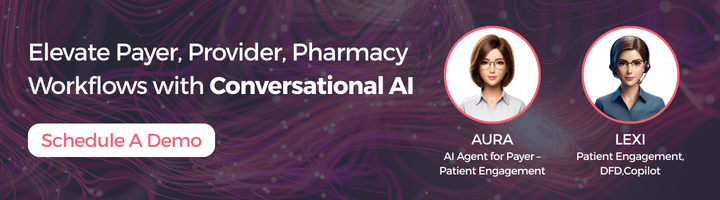
Conversational AI supports healthcare organizations across the ecosystem by automating interactions, streamlining workflows and improving experiences for both patients and staff. Its impact varies by stakeholder, with providers, payers and pharmacies each unlocking distinct value.
| Stakeholder | Key AI Use Case | Primary Benefit |
| Providers | Patient Engagement, DFD Automation, Appointment Scheduling, Triage & Support | Reduced Admin Overhead |
| Payers | Eligibility Check, Claims Tracking, Billing Support | Instant Member Support |
| Pharmacies | Refill Notifications, Order Tracking, Clinical Guidance, Tailored Promotions | Higher Medication Adherence |
How AI Agents Transform Provider Workflows and Patient Access
- Omnichannel Patient Engagement – Chatbots and Voicebots in healthcare act as the primary point of contact across 15+ digital channels (including WhatsApp and MS Teams), providing multi-lingual support and reducing call center wait times.
- Automated Appointment Access – Patients can schedule, reschedule, or cancel appointments independently, improving access to care while lowering administrative overhead with the help of chat AI & voice AI in healthcare.
- Clinical & Administrative Workspaces – Chat and Voice AI in healthcare supports staff by summarizing patient interactions, updating EHR data and automating note-taking, allowing clinicians to focus on care delivery rather than documentation.
Optimizing Payer Operations and Member Engagement with Conversational AI
- Real-Time Eligibility Verification – Chat or Voice AI in healthcare provide instant access to coverage details, co-pays and deductibles... eliminating long hold times for members.
- Automated Claims Adjudication – Healthcare AI extracts and validates data from claims and policy documents, accelerating the adjudication process and improving decision-making accuracy.
- Billing Support – Automate billing inquiries and payment assistance, helping patients understand charges, verify insurance and make secure payments with chatbot & voicebot in healthcare.
How Conversational AI Boosts Medication Adherence and Pharmacy Efficiency
- Prescription & Refill Automation – Chatbot & Voicebot in healthcare handles refill requests and delivers automated notifications via SMS or voice, significantly improving medication adherence and patient outcomes.
- Clinical Guidance for Pharmacists – Behind the scenes, Chatbot & Voicebot in healthcare guide pharmacists on potential drug interactions and dosage considerations, ensuring safer, more efficient care.
- Personalized Loyalty – AI enables pharmacies to tailor promotions and engagement programs, supporting long-term patient retention and trust.
Floatbot.AI
Built specifically for regulated, high-complexity environments, Floatbot.AI enables providers, payers and pharmacies to deploy conversational AI across voice and digital channels while maintaining compliance, security and workflow alignment. Our AI Agents integrate seamlessly with EHRs, payer systems, pharmacy platforms and enterprise tools.
From patient engagement and eligibility verification to clinical documentation support and pharmacy operations, Floatbot.AI helps teams streamline workflows without compromising care quality.
As healthcare continues to evolve toward integrated, patient-centric models, Floatbot.AI provides the conversational AI foundation needed to support smarter operations and more human interactions at scale.